Showing posts with label vegan. Show all posts

Sunday, 28 April 2013

Seedy bread - sharing the flours with others and the wonders of Solanic potato protein


I responded to a query about bread on http://glutenfreeguerrillas.healthunlocked.com.  I normally don't contribute recipes for bread on this site as I now always use the potato protein I got from a LinkedIn contact, and this is not available in the shops.  If you buy it from the company the minimum order is 15kg - and given you need a few grams/couple of spoonfuls for a loaf of bread this is an enormous amount.  However, I offered to send some samples out to people if they wanted, and a batch of the flour I use, as I want to get feedback on my usual loaf.  

I have been wondering whether to take the step of trying to bring this flour mix to market, which would be a lot of work, so feedback would be useful.  I have also been talking to the company about the possibility of the potato protein being made available in consumer sized portions.  This potato stuff doesn't upset my guts at all - I can't use zanthum/xanthum or other gums, and even have to stay away from flax/chia seed.  It helps gf loaves to keep their shape so they don't slump if you want a full size/high loaf, and give improved texture even to pizzas and other flat breads.


I sent out six batches of the flourmix- enough for a loaf made in a one pound loaf tin, and 30g of the potato protein. I do hope these packages survive the post- I went to bed fretting that I hadn't double bagged everything.  I sealed them in cellophane and built small posting boxes by chopping up a large box and wrapping with lots of parcel tape, so hope the transit is fine.  I thought I should include a photo and instructions, so took the usual plain loaf ingredients and added a little cocoa and pumpkin and sunflower seeds to give a warm seedy loaf.

------------


This mix is made from urid lentils, tapioca, rice and potato.  The potato protein that I have have included in the small bag should be used at about 2%of the flour for yeast breads.  Makes great pizza and other flatbreads as well as the loaf.   I am thinking about trying to package it or a variation on it so would be glad of your feedback.  I have a gf house and am very sensitive so these samples should be completely gluten free.

The bag has approx 300g of flours, enough for a small one pound loaf tin.  Mix it the yeast- either a teaspoon or two for a quick rise or half a teaspoon if you want to let it rise more slowly to develop a sourdough flavour.  Put salt and sugar in if you like.  Add 250ml cold water. You can also put a little cocoa and some pumpkin and sunflower seeds for a seedy loaf, or other flavours to suit your taste.

Mix the batter thoroughly with a wooden spoon or food mixer.  It will look like a thick  cake batter.  Pour the mixture into a greased non-stick loaf tin.  It should come about half way up the sides.  For a quick loaf put this in the oven with a tray of hot water in the bottom and leave it to rise.  You want to let it rise about one third - not quite to the top of the tin.  When it gets to that point turn the oven on to 175C (fan) and set timer for 45 minutes.  It will rise further in the heat but shouldn’t come over the top of the tin as the batter hasn’t the strength to go up on its own. It needs a slower bake than wheat bread.

If you want more flavour and a slightly more artisan-style texture leave the loaf to rise somewhere cool - if you want to retard it to fit in with your schedule just put it in the fridge.  Then bake as before.

Tip out the cooked loaf and cool on a baking rack. I cool them on their sides to encourage them not to sink.  Don’t try to slice before they are cold or the bread will stick to the knife.

This should be ok for several days, or slice and put in the freezer.

Rinse your dirty dishes in cold water promptly - the batter sets quite hard.

The photo is the loaf I made this morning when I bagged up the flour (at the moment I still grind my own lentils before mixing the flour, so quite an effort).  This has half a teaspoon cocoa and a small handful of seeds mixed into the dough, and a few more seeds sprinkled on the top.  A loaf I left out to see what happened a couple of weeks ago was still ok to slice after a whole week, but I normally slice the bread and put it in the freezer. 


------------

I'm hoping to get some feedback shortly.  One person suggested that we buy a big bag of the potato protein and share it out between us.  That is a great idea.  If anyone reading this would like to join in and try so of this stuff let me know.


Thursday, 13 December 2012

Turkey alternatives- vegan quinoa, butternut squash and cashew nut roast


It is always a good idea to have an alternative to turkey as people may be vegan, vegetarian, pescatarian or just not like turkey.  I had a look at a few recipes on the internet, including the useful evaluative series at the Guardian. I wanted to use roasted butternut and cashew, so also looked at the River Cottage nut roast.  I also fancied including cranberries, and found this pretty-looking recipe from Jamie Oliver.  I wanted this dish to be a complete protein source - it seems to me that too often the vegetarian option in restaurants hasn't thought through either the flavour balance or the nutrient balance.

I made two versions, I'll post the second, including mushrooms, later.
I cooked a whole 300g bag of qunioa, rinsing thoroughly first, to make both recipes.
I cooked 300g of fresh cranberries for a couple of minutes with the juice of a satsuma, 1tbsp sugar and 1 tbsp chilli jam.  This was used in both recipes.

Ingredients
600g cooked quinoa
250 roasted butternut squash (peel, chop, rub with oil, roast in hot oven half hour)
250g cashew nuts, chopped (quick blast in blender, be careful not to powder)
1 red onion, chopped, cooked until soft in 1 tbsp oil
1 tsp mixed herbs
1 tsp vegetable bouillon powder (make sure gf)
1/4 tsp ground cumin
1/4tsp pepper

cranberry 'topping'

Mix all the ingredients and check seasoning. As you stir the mixture the butternut squash pieces will break up  If any are too large just cut them. You want a mixture with some contrast but no large lumps.

You can eat this as it is to test or fry a small blob to give a crisp outer to test what it will be like when baked. You may well want more salt as I eat very little (just enough to stop my tendency to low blood pressure). You may also want to reduce or remove the cumin if you don't like its distinctive earthy taste. Try some sage as an alternative.

Place a layer of the cranberries in the bottom of your dish and pack the quinoa mixture on top.  I used individual baking cases - the sort often used for lemon drizzle, as some of these are being given away.  I made eleven individual nut roasts from this mixture, filling the containers to just below the surface. Drizzle a little oil on top to help it go crisp and brown when baked.


before baking
Bake in the oven with other things you are cooking for about 20 minutes.  These can be frozen; just get out of the freezer a couple of hours before you want to cook them if they are the individual size. These tiny individual portions are easy to tuck in next to other items.  Leave them to rest ten minutes before serving.

This nut roast has a light flavour and slightly crumbly texture.  It would go well with the other traditional items on a Christmas dinner.  Just remember to have some gf vegan gravy to go wit it.


Sunday, 14 October 2012

Nakd nut and fruit bars

I had an unexpected pleasure the other day.  I was asked if I would review Nakd Gluten Free Foods cold pressed nut and fruit bars. There is supposed to be an accent over the 'a' but I havent figured out how to add one.

 I had never tried them before as I tend to make my own handbag foods, or if I need to buy something I have always bought the Eat Natural fruit, nut and seed bars.

A mixed box of bars arrived shortly after.  I didn't try them straight away as I was a bit glutened, then I had to go and look after a sick grandchild, caught her germ...anyways, today I tried the whole range.

I got sent an astonishing range of different flavoured bars:
cocoa orange
berry delight
cocoa delight
cashew cookie
rhubarb and custard
ginger bread
caffe mocha
cocoa mint
cafe mocha
pecan pie

They all say "Yummy raw fruit and nut bar" and are gluten, wheat and dairy free. Most of them are made with dates and cashews and a few other things like cocoa, spices, pecans and unspecified natural flavours.

The packs are a neat small size, and would be good to keep in a pocket or handbag for munching while out.  I found them quite difficult to open, but eventually figured that you have to open out the seam and grasp firmly at the middle and tug. I haven't tried it with chilly fingers at an outdoor event, or with gloves on - they would be good on skiing trips so maybe I'll test this aspect next season. They do have the advantage that the writing is clear and easy to read - the Eat Natural bars, in contrast, are not all gf and you have to open the seam flap and peer carefuly to check each flavour.

My first impression was 'how weird!'.  They are smashed nuts and fruit squished together.  I thought, 'why eat smushed fruit and nuts rather than a handful of whole nuts and fruit?' - I still have reasonable teeth.  Then it occurred to me that this is a tidy way of eating nuts and fruit and it can be done without having to touch the food.  This is always a useful aspect when trying to avoid gluten contamination. They are also quiet to eat, so if you are munching in a library or other spot where discretion is useful they would be very suitable though the packaging itself makes a bit of a noise.

The first two bars I tried didn't seem to have much flavour difference, but today I opened one of each and tried them one after the other.  Some of the flavours are totally weird, like the rhubarb and custard, but I reckon that this means that everyone could find at least one flavour they liked.

The bars are vegan, have no added sugars or syrups, and each one gives you one of your portions of fruit for the day.  Handy little things - if you try one and don't like the flavour try a different one.  They certainly have a wider flavour range than any other snack I have encountered that can be eaten by coeliacs and others with gluten intolerance. And if you lose all your teeth you won't have to find someone to chew your food for you!

...
throwing the box away I noticed the text on the bottom:

"Hello, Gorgeous.  Fancy meeting you here.  You are aware, of course, that you have this box upside down.  We salute your curiosity and suggest better reading can be found at EATNAKD.COM"


Sunday, 26 June 2011

Almond and blueberry cookies


A vegan guest at a party, so a quick cakey biscuit.

tapioca gel made with 10g tapioca (1 tbsp) and 100 ml water, mix and cook until clear, cool
150g flour (40% urid, 40% tapioca, 20% cornmeal)
50g blueberries (dried)
50g vegan margarine
50g sugar
50g flaked almonds plus extra for the top


Mix flour into gel, mix in sugar and margarine, stir in blueberries, then carefully stir in flaked almonds.  Spoon small mounds on a lined baking sheet or spread in a tin to cut into bars. Lightly pat extra flaked almonds on top.  I made fifteen cookies from this batch of dough.

Cook for 20 minutes at 170C until golden brown.

Delicious cookies - definitely a make again recipe.


Saturday, 28 May 2011

gluten free chappattis / wraps


stack of gluten-free flatbreads

As easy flatbread that can can be served with curry or salad or used as a wrap.

I tried two recipes, on using tapioca gloop, the other using water to bind.  I did the one with the tapioca gloop after being disappointed with the way the flatbread cracked when being rolled.

For those of you who haven't tried tapioca gloop (I think others call it gel) it is a great product for giving flexibility to foods, and making doughs easy to roll.  Just take 10g of tapioca flour, mix it with 100ml cold water, and stir over heat until it goes clear.  Cool and use as the liquid in the recipe.


First recipe
Ingredients

  • 50g buckwheat flour
  • 100g gf flour (40% urid, 40% tapioca,20% cornmeal)
  • 2 tbsp oil ( I used olive)
  • 60 ml water
  • 1 tsp baking powder
  • pinch salt and sugar if wanted


Whisk flours, baking powder and flavorings together.

Stir in oil and water and mix until smooth and flexible.  Add extra water if needed so that when you press the dough the edges don't crack.  Leave to sit under a damp cloth for a few minutes.  As you take pieces to roll cover the rest of this dough with the damp cloth to stop drying out.

Take a golfball sized piece and roll thin, keeping pin and board well dusted with flour.  Cook on a medium griddle until just cooked - the main part of the flatbread will look whiter and bubbles will form, any hot spots will be gold to black depending on quite how hot your griddle is.


Turn over and cook second side.  If you have big bubbles holding the flatbread off the griddle you can press down with a cloth or paper towel.  When I was little and being taught how to make chapatis this is what we did to get the dough to form one giant bubble so that the bread could be opened when cooked.  You probably won't get quite this effect, but it is a technique for ensuring even cooking.


If you like a rustic charred effect you can put the flatbread on an open flame when ready - this used to make our chapatis expand like balloons.

Recipe 2

Having been disappointed by the flexibility I made the recipe again using the same ingredients but tapioca gloop and reducing the water.

Ingredients
50g buckwheat
100g flour (40%urid, 40% tapioca, 20% cornmeal)
tapioca gloop made with 10g tapioca flour and 100ml water
pinch salt and sugar
1 tsp baking powder
2 tbsp oil
extra water to make smooth dough.  I needed another 30ml

Knead until smooth, by hand or with machine.  Cover as before with damp cloth.  Roll and cook as before on medium griddle.

During the cooking stages these two flatbreads behave pretty much the same.  The difference shows if you handle them the way you would if filling.  Here are photos of both types of flatbreads rolled and unrolled twice for comparison.  Unless you are intending to eat these flatbreads immediately you make them and don't much care how they handle, it is worth the extra few minutes making the tapioca gloop/gel.

flatbreads 1(top) and 2 - rolled

flatbreads unrolled , 1 on right

flatbreads re-rolled, 1 on right


flatbreads opened out, 1 on right

Friday, 27 May 2011

samosa - gluten free and vegan

samosa - gluten-free and vegan

More for the deep fryer collection.  Samosas are a popular snack food, and very versatile as you can fill with any flavour filling ( I found myself wondering what banana and chocolate would be like).


I started by using pastry based on the recipe at http://www.samosa-recipe.com/Samosa_Pastry.html.  I didn't use their filling, as it needed cooking, so based mine on a recipe from http://www.indianfoodforever.com/snacks/samosa.html, just making it easier given what I had in the fridge and pantry.


dough

  • 225 flour (40% urid, 40% tapioca, 20% cornmeal)
  • 130ml warm water (approx - add enough to get good dough)
  • 2tbsp veg oil
  • salt if wanted

Mix salt with flour if using, make well in flour and put in oil and enough water to make a pliable dough.  Wrap and leave for half an hour for flour to absorb liquid.


samosa dough


filling
  • potato cooked and mashed - I microwaved four smallish potatoes, slipped the skins off and chopped coarsely
  • 1 cup frozen peas
  • 1 inch of ginger, finely chopped
  • chilli to taste.  I used a little green chilli
  • garam massala 1 tsp
  • 2 tsp korma or other curry paste, or your own spice mix.  I like Patak's.
  • 1/2 tsp oil


If you mix all of these together while the peas are frozen you can stir quite hard, the potato mashes nicely, and the peas stay whole.

The filling is ready to eat as it is and only the pastry needs cooking.

This amount of filling only just did all the samosas.  Make more than you think you want, adjust the seasoning until you find it hard to resist (which is why I ran out, I think) then leave to cool.


Technique

Deep fryer set at 170C

Cut the dough into pieces - this amount will make 24 smallish samosas.  You won't be able to roll the pastry quite as thin as a wheat pastry, but it works pretty well.  Flour the board and your rolling pin well as you work and keep moving the pastry so it doesn't stick.  If you do find it sticks just squish it back together with a little extra water and put it back with the others for a moment.  Also, if you find the dough has dried out just do the same.  It seems quite forgiving, and the pastry that I re-squished several times seems to have worked the same as pieces that rolled perfectly first time.

Roll each portion into a circle and cut in half.


Working carefully, as the dough is fragile, brush a little water along the cut edge and roll into a cone, supporting with the thumb and forefinger of one hand. I just dipped a finger in water for this but you can use a small pastry brush.


Fill carefully - not right to the top.


You need enough pastry left over to be able to fold one side down, brush with water, then fold the other side so that it sticks.  If you get holes stick a scrap of pastry on with water.


Put on a floured tray or plate until you are ready to cook.  Place a few samosas in the fat at a time, shaking gently now and then.  As with all fried food don't overcrowd the fat.  Remove when they are a light golden brown all over.


frying at 170C


Drain on a cooling rack.


 I'll see how they respond to freezing and thawing later.  TT says they taste and feel pretty much like any other samosa he has had.

sorry about odd bits of formatting - Blogger is behaving strangely at the moment


Update;  tasted good and held together well after freezing.  Heated some in the oven until crisp, others were eaten cold after they had defrosted.  Both were good.  Definitely a good recipe to make for standby snacks from the freezer.

Wednesday, 5 January 2011

empty cupboard vegan gluten-free minestrone

minestrone with rosemary crackers

I need an easy supper after all the complex meals I have been making and I haven't been grocery shopping. I fancied a minestrone and thought the River Cafe winter minestrone looked good.
http://www.bbcgoodfood.com/recipes/1732/the-river-cafes-winter-minestrone

Of course I lacked a lot of the ingredients, so here is my version.

250ml left-over vegetable gravy made with vegetable stock and caramelised onions.  Otherwise, slow cook an onion and then add stock or a stock cube.
250ml water
1 garlic clove
pinch black pepper
1/2 red pepper, chopped - I like the long pointed ones.
1 can tomatoes, chopped, pureed or whole- but then smash a bit.
1 can borlotti beans -  put half in soup whole and the other half blitzed with some of the stock to make a puree to thicken soup
1/2 tsp tamari ( gluten free version of soy sauce)
chunk of savoy cabbage, chopped
handful flat-leaf parsley
handful gluten free pasta - I used Tesco Organic shells - they hold their shape well.


Put all the ingredients except for half the parsley, the cabbage, the pureed beans and the pasta to cook.  The flavours will improve if you can leave this simmering for twenty minutes or so.  Then add the cabbage, pasta and the rest of the parsley.  When the pasta is nearly cooked add the pureed beans.  If you put the pureed beans in earlier you will have to stand over the pan stirring as they will tend to stick to the bottom.

If you have other vegetables that you want to use up add as you think fit.

If you like and can tolerate dairy, grate some Parmesan on top.  Alternatively, drizzle some pungent olive oil on and serve with my rosemary crackers, toasted pine-kernels, or Lazy Bread spread with garlic and toasted.  An easy, nutritionally balanced and warming supper that will be good to eat tomorrow for lunch if there is any left.

Thursday, 30 December 2010

gluten free vegan Rosemary and Olive Oil Cracker recipe - thin and crisp

Rosemary and Olive Oil gluten free crackers
Two things combined to create these crackers.  A sudden yearning for crackers led to this recipe :
http://www.seriouseats.com/recipes/2010/12/gluten-free-tuesday-easy-homemade-crackers.html . The second thing is my new pasta roller attachment for the food mixer.  


Anyone who has made anything with polymer clay will know that it tends to fracture and is hard to work with until it is kneaded, and a standard way to do this is to put it several times through a pasta roller. As my manual roller is now dedicated to polymer clay I have an electric one, which is such fun and so useful for these stiffer gluten free doughs.  Run a dough for crackers or pasta through a few times and you get a smooth transparent sheet without any real effort.  When you start the dough will tend to shatter and be irritatingly hard to control.  Just gather it up, reform a slab and pass through again, and after five or six passes it will be smooth and stay together and you can get a sheet of dough a meter long it you can hold it one piece.


Of course I didn't follow the recipe, but it did lead to a rosemary and olive oil cracker that is very thin and crunchy and crisp.  I don't yet know how well they will age - I'll add to this post later when I find out.


Ingredients:
100 g flour ( 40%urid, 40%tapioca, 20%cornmeal)
1/2 tsp baking powder (check gluten free)
1/4 tsp chopped rosemary
1/4 tsp sea salt
1 tbsp olive oil
1/4 tsp lemon juice
water to mix to firm dough


cracker ingredients


Method:
Stir all ingredients except water together until evenly mixed.  Add water until you get a dough you can just squeeze together.  It will be a bit tough and hard to shape at this stage.  If you don't have any helpful machinery kneed it until it gets pliable.  I use the pasta roller attachment on my Kenwood mixer.


On the next pass this sheet of dough became three times as long and still all in one piece.  Make thin sheets and either cut to shape in squares and re-roll the trimmings, or just slice the dough into shards with the ragged edges - they taste just as good and look interesting. 


Bake at about 170C far, 180C, for about six minutes until they are just tinged with gold.  Place on rack to cool then store in an air tight jar.  I don't yet know if they will lose their crispness when stored, but a quick reheat will fix that if necessary.  I'll add to the blog when I know.


The crackers have little air bubbles and speckles from the rosemary.  You can of course vary the flavourings any way you like.


Tuesday, 14 December 2010

easy gluten-free vegan lasagna

gluten-free vegan lasagna


I was exasperated the other day that I had to wait in for a courier that never came.  I set out to make lasagna but had no eggs, and couldn't go out to buy any.....so here is a vegan version which turns out to be much better than my usual lasagna.  This is so much better that I have ordered an electric pasta roller for my Kenwood food mixer so that I can make loads for my sister.  I tried rolling the pasta in my old pasta machine, which I have used for polymer clay, and it rolled very easily.  I threw that batch away (speckled blue and orange..) but it did at least allow me to be sure that a normal pasta roller would be helpful.

I made the lasagna with tapioca gel and what has now become my standard flour.  I put the flour and the gel in the food mixer and let it do all the hard work.  When the dough was soft I let it rest, wrapped in plastic, in the fridge for a while, and then rolled it thinly.  I tested the wet rolling - between dampened clingfilm, and dry rolling with flour, and found the dry rolling worked fine and made the resulting thin sheets easier to handle.

I then pre-cooked the pasta for a few minutes in boiling water and made two lasagnas.  One we ate for lunch, the other has been frozen to see how the lasagna copes with being frozen as a pre-prepared meal.

I also made a tiny lasagna with some of this dough that I had made yesterday, pre-cooked in water and then dried.  Layered with a simple tomato sauce and covered in cheese (dough is vegan - use how you want) and baked - it worked very well.  The layers of pasta stayed distinct, had a smooth soft texture, and tasted good.  The long-term hope is to be able to make neat pre-cooked lasagna sheets so that they can be made in advance and used as a convenience food by people who don't like cooking.

tapioca gel - 10g tapioca flour, 100ml water, stirred together and cooked until clear.
150g flour - 40% urid, 40% tapioca, 20% polenta.

If any UK readers would like to try this flour mix if they would let me know - I'd like to get some feedback from others about this mixture. I think it is better than any of the other flours on the market and doesn't need xanthum gum.  I now use it for cakes, pastry, cookies, pasta and bread.

.........................

reheated in microwave from frozen this pasta is still good

Thursday, 9 December 2010

Ravioli

gluten-free egg-free ravioli
I was asked for a description of the ravioli I referred to in a previous post.  I hadn't yet written up how to make ravioli as I wasn't  satisfied with the texture.  Today I was feeling in need of some experimental therapy - I am supposed to be marking essays - so decided to have another go at the ravioli, altering the proportion of the flours I use.

When I used to make fresh pasta with wheat flour I had found that the more egg you used the more succulent the pasta was.  I ended up using Jamie Oliver's recipe rather than Nigella Lawson's.  Up until now I have always used egg when I have made pasta.  However, I realised I had run out of pasta and I was waiting in for a courier so couldn't nip out and get any.

I made some of the tapioca gel I have used in the past when leaving egg out of recipe.  I took 5g of tapioca flour and stirred it into 50ml of cold water, and then cooked it, stirring continuously, until it was a clear gel.
tapioca gel

 I let this cool a bit while I weighed out 50g of urid lentil flour and 60g of tapioca flour, and then I squidged the flour into the gel.  I needed a bit more water to get a dough so just added some until the dough held together nicely.
mix flour into gel

I mixed this thoroughly until the dough was soft and a bit stretchy. Start with a spoon but you will soon need to pulverise it with your hands. The gel is bouncy and resists the flour.  Once you get a smooth dough knead it until it is a bit stretchy. I just held it in both hands and pulled and folded and pulled and folded until I was happy with the texture.

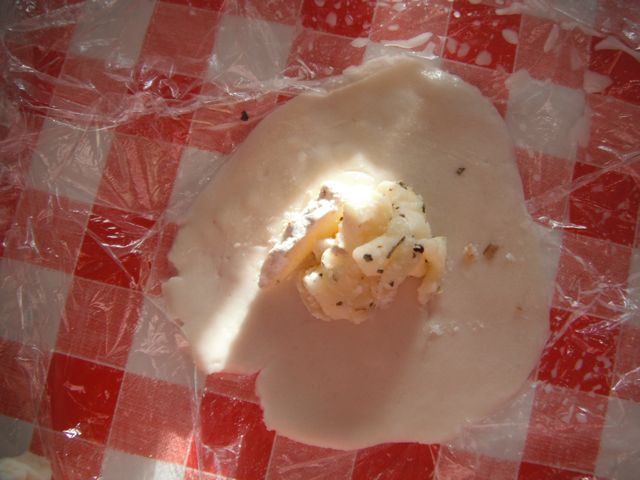
I tried rolling this out but found that the dough tended to stick and then tear when I made ravioli the usual way.  It was much easier to make individual pockets of dough by squeezing a marble of dough in my hand until I had a thin disk, putting the filling in the middle, dampening the edges and then gently sealing them together.

I made a second batch and found that the easiest way to make the ravioli (sorry any Italians out there who think I am using the wrong word for the shape) was to dampen a piece of clingfilm / plastic wrap, place a marble of dough onto this, fold the cling film over and squeeze the dough into the desired shape.  Provided you don't get over excited and make it too thin this gives you a smooth circle of dough for your filling.  Keep the whole thing damp and it wont stick too much and it also means the dough sticks to itself when you press it around the filling.

ball of dough on damp cling film

press out a circle between two layers of damp film

place filling on circle

fold over cling film and use to press edges together

I cooked these for about eight minutes in boiling water.  The length of time you need will depend on how thin and large you make them just as with wheat pasta.

boil in water
These little pasta parcels had a smooth yielding texture and held the filling well.    Enjoy playing with fillings and sauces - the choices are endless.


...............

I froze some of these ravioli and cooked from frozen.  They retain their shape and texture though the filling used went a little rubbery.  Pasta worked fine - need a different filling.

Wednesday, 1 December 2010

Mincemeat recipe - sulphite free

cranberries, blueberries, raisins and candied peel


I got these written in the wrong order - I haven't shown you the mincemeat I made with the candied peel.

I started with Delia Smith's mincemeat recipe from Delia Online.  I then changed a lot of items to suit my store cupboard.  I made a large amount as it takes a longish time to make and keeps for a long time too - make it once and use it all year.

Ingredients
1000g raisins
700g dried cranberries
600g soft dark brown sugar
500g dried blueberries
340g candied peel chopped small
320g hard white vegetable fat, chopped small  - if you are making for immediate consumption you can leave most of this out or put in a small amount of vegetable oil.
225g apple, chopped
juice from the oranges, lemons and grapefruit used to make the peel
6 tsp mixed spice
1tsp cinnamon
half a fresh nutmeg, grated.
8 tbsp brandy


Mix everything together apart from the brandy. Cover and leave to sit for twelve hours.  Cover bowl with foil and place in a warm oven ( 120degreesC) for three hours.  Stir as it cools.  Add brandy and stir.  Bottle or use.

Tuesday, 30 November 2010

Vegan and gluten-free mushroom stroganoff

mushroom stroganoff

Those of you that can remember what it was like to be a vegetarian in the 1970's and 80's may view a recipe for mushroom strogonoff with a twinge of loathing.  For a long time, after the sole option at restaurants was an omelet, or if it was really posh, a poached egg, the standard veggie option was mushroom strogonoff.  I haven't eaten, let alone made, a mushroom stroganoff for at least a decade.  However, in the store today mushrooms were cheap and I had pastry ready in the fridge so I thought a pie with mushrooms would be a good supper.

I ran out of time doing other things so didn't  get around to preparing the other ingredients for my pie.  Mushrooms being sold off cheap because the store wants to get rid of them need using...stroganoff with baked potatoes seemed the ideal solution.

I used a recipe from http://vegbox-recipes.co.uk/recipes/mushroom-recipe-2.php simply because it was the first one to lad - my Internet was being very slow and I kept changing URLs till I found one that came up before my patience vanished.


It included wine and cream, and I didn't have any wine and, being lactose intolerant, didn't want to use the cream.  I added half a can of borlotti beans to increase the protein of the dish and to act as the thickener.  I blitzed them in a blender before adding them; they gave a thick creamy texture that satisfied even the diary lover taste-buds of my Tolerant Taster.


fry mushrooms with onion and garlic

  • 500g mushrooms, wiped and cut into chunks
  • 200g Borlotti beans - pureed
  • c 100ml water - more as needed
  • 1 tsp smoked paprika
  • 1 tsp whole grain mustard
  • 1 teaspoon gluten free soy sauce
  • 1 tbsp tomato paste
  • 1 medium onion- finely chopped
  • 2 cloves garlic - minced
  • 1 tbsp olive oil
  • handful chopped parsley


Fry onion in oil until translucent.
Toss mushrooms in paprika.
Add garlic and mushrooms to frying onion and cook until the mushrooms start to look brown and cooked
add borlotti paste and water and stir well
add other flavourings apart from parsley.  Cook until thick and luscious looking.  Stir in chopped parsley and serve.


add borlotti paste to mushrooms


I served this with baked potatoes and fresh buffalo mozzarella for anyone that wanted it.

Excellent flavour and really easy to make.  I'll definitely add this to my regular repertoire of simple supper dishes.

Thursday, 25 November 2010

Update - Chocolate christmas cake - gluten free flour and dairy/dairy-free taste test

On November 19th I posted a trial of the BBC Good Food chocolate Christmas cake, using three different gluten-free flours and dairy/non-dairy fat ( http://bit.ly/9TC6E3).  We just retested the cakes, on Nov 25th, as they have had some time to mature.

The flavours have blended with the extra time and it isn't so much of a shock to have chocolate with fruit lumps.  The textures of the cakes are closer together.  We still liked the one made with my own blend of flour and the butter best.  The Bob's Red Mill flour, from lavidafood.com, made with Pure, was good, so if you want a vegan gluten free cake made from standard flour rather than mixing your own I suggest this is a good choice.

Doves Farm was still producing a fine pasty texture - I think it is the rice in the flour mix.

Sunday, 24 October 2010

Apple and raisin cookies- vegan gluten-free


80g eating apple cut in small chunks
50g raisins
50g urid lentil flour
50g tapioca flour
50g gf flour mix or cornmeal
50g sugar (more if you want a sweeter cookie)
1 tsp mixed spice
1/2tsp baking powder
20g nuts – whatever you like
60g sunflower margarine
Juice to mix to sloppy dough – I used pear puree, amount will depend on flours used.
Sift flours and baking powder and spice together. Beat margarine, sugar and flour mix together. Stir in raisins, apple and nuts and add juice to get texture you want.
Drop onto greased cookie sheets or baking paper, leaving gaps for spreading. Bake at 170C for 10-15 minutes for chewy cookies. If you want crisper cookies turn the oven off and leave in for another ten minutes. Cool on rack.

Saturday, 23 October 2010

Vegan cranberry and sweet potato muffin Gluten-free


Ingredients:

60g sugar

60g sunflower margarine

50g grated sweet potato (unpeeled)

30g cranberries

gel – 10g tapioca 60ml water

25g urid lentil flour

15g tapioca

15g polenta

1tsp baking powder

1/4tsp ginger

0.3tsp baking soda

Sift dry ingredients together. Mix in margarine then stir in sweet potato and cranberries. Mix in gel – this takes a bit of effort; just keep going until evenly dispersed. Place in muffin cases and bake for 25-30 minutes until crisp and golden on top and springy to touch. Oven temperature 170 degrees C.


These muffins are light and the cranberries shine like jewels. The hint of ginger isn't obvious, just adds a touch of warmth to the flavour.


Views of Mr Taster

"The fabric of the matrix holds together in a way that is much more like something with gluten in it. It is springy and doesn't collapse when you bite it or press it with your tongue, keeping its three dimensional structure. Sweetness is evenly distributed and the top has crunchy sweetness - did you sprinkle it with something? Works very well."